
"I do my best"
#14 Kriti is one of the most optimistic people I've interviewed. But her positivity is hard won.

While asking around for potential interviewees for this blog, I was pointed in the direction of a tech founder who moved to Silicon Valley from Bangalore, India. When I got in touch with him, he excused himself because his calendar was clogged with work stuff, but wrote back later, saying: “… I feel moving is tough, but tougher for the spouse …”
He put me in touch with his wife Kriti, with whom I sat down a few weeks ago. This is her story. As I begin to write it, I am reminded of a comment on a recent LinkedIn1 post about this blog: an erudite reader of ‘I Live Here Now’ wrote “… This is crucial sociological and anthropological evidence that may never see the light of the day …”
Indeed, that’s how I felt about this story, not least because the woman I met has successfully reckoned with the storm of migration and is now in sunnier climes.
“But when I shifted here few years back, the story wasn’t the same,” she said, as we settled in with our beverages. Over the next hour, she told me her story, warts and all, with dignity and grace, even when I probed her about the harsh emotional realities she has had to confront. I left with a sense of optimism and hope.
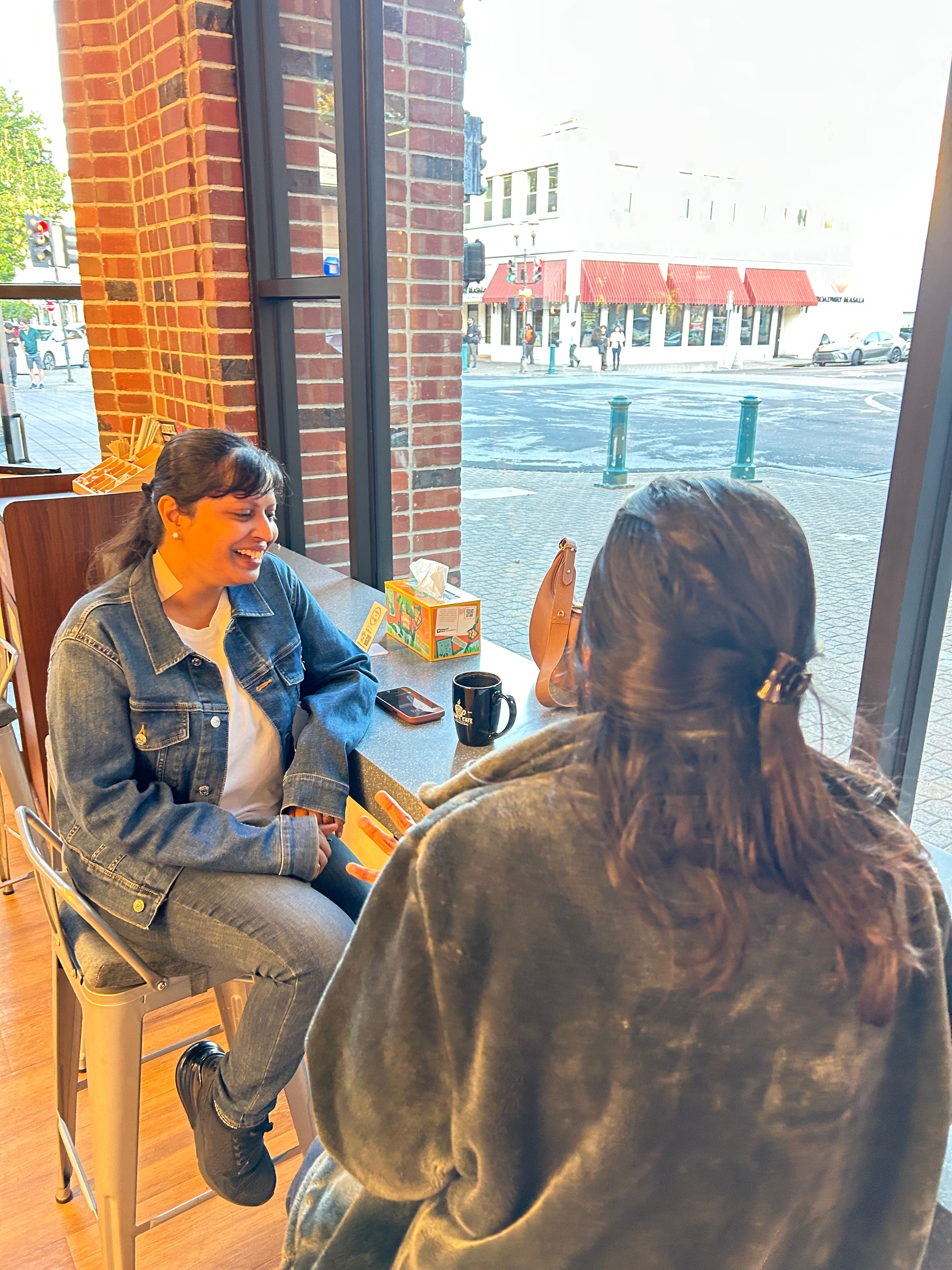
“It was a big change because I had not lived outside Delhi,” she said about her move from India. “I had not imagined moving from Delhi to Bangalore!” And here she is in the Bay Area, sipping Yemeni tea with me in Redwood City. Her American name, which she used to place the order, is Kit.
Kriti got no more than a few weeks to prepare for the move.
Soon after they got married, her husband visited the US for a round of alpha trials for his startup. It must have gone really well because he came back and said to her — and this is her quoting him from back then — “‘Kriti, we are moving to the US.’”
She didn’t even have a US visa then.
“In the next 20 days, we just sorted my visa.”
This was during the peak of the pandemic; India’s homegrown vaccine, covaxin, was not accepted in most places at the time and they had to go to Mauritius to get their visas stamped, isolate there for two weeks, and then fly to the United States.
“We just packed our life in two suitcases and moved to the US,” she said, recalling the madness of the speed with which things changed. “My life changed in those two weeks…. he chose to be here because of his business. But I was informed... and then here I am.”
The real journey began once the plane landed on American tarmac, of course.
“The next struggle was being in this environment - I don’t think it’s the most welcoming.”
Kriti is referring to the Bay Area’s disproportionate skew towards engineering, something most ‘visa wives’2 who’re not in tech are painfully familiar with. Besides, her visa didn’t permit her to work here.
Thus began a crisis of identity and purpose, especially when she’d meet new people, who’d unfailingly ask her: so what do you do? Clever quips like “I manage this guy,” referring to her husband, and the endless minutiae of things she’d do around the house, only went this far. “I wasn’t driving back then. The only job that I had at hand was to cook,” she said. Her husband is building a cooking robot; the irony is not lost on her. She is even able to laugh about it now.
“I am not sure in what words to tell you how ‘out of purpose’ my life felt.” I told her I could empathize and meant it.
“When you tell someone ‘this is what I do’ they are instantly not interested in talking to you… maybe I’m reading too much into it, I don’t deny that, but sometimes you can see the instant loss of interest in their eyes. Eyes don’t lie. So it’s the constant fear of judgment that started coming up because people would ask those kinds of questions which would put me in self-doubt.”
A lot of their outings were engineering or tech related. “He tried taking me to these founder events. And none of them helped. I kid you not, the day I landed here, he took me to an event. People were talking about NFT.”
This kept happening. “They would use terminology that I don’t understand,” Kriti said. It also didn’t help that the friends she made, through her husband’s circles, were mostly Indian and mostly engineers. “I don’t understand the ‘language’ they speak. It would just deepen the insecurity in my head.”
The Kriti I met looked and sounded very secure, though.
“It’s been a journey to move on from that — it’s like writing your own story.”
And move on she did. She started by up-skilling and educating herself about NFTs, blockchain, metaverse, ChatGPT, Claude, AI… the whole shebang.
Kriti is from a commerce and finance background. In India, she was an aspiring, and somewhat disillusioned, chartered accountant. She got an equivalent degree here. “I took charge of my own life,” she said. “If today someone asks me ‘what do you do?’ I say ‘I’m a CPA.’ It’s good enough.”
For now, she means. “I don’t want to stop there. I have promised myself I will continue to up-skill myself and understand new things.”
Kriti still doesn’t have a visa that comes with a work permit but she has come a long way, nevertheless, especially on the front that is hard to measure. She made a conscious effort to drive, work out, read, make her own friends and study.
She deliberately tries to do things that make her introvert genes squirm. Like agreeing to talk to a stranger brandishing a blog.
“I’m taking control of my life, I am completely enjoying that freedom,” she said. “I want to feel free. I want to take decisions for myself… there are enough resources out there. If someone wants to do something with their life, they’ll find a way out. If they don’t, then it’s their own hesitation that’s stopping them.”
She draws inspiration from friends who brought her timely gifts in the form of personal life lessons or precious advice.
“I have a friend with a similar journey as mine. She volunteered for the longest time at Stanford. And then she went on to do her Master’s in Public Health at Johns Hopkins. She did not stop. She also took charge of her life, went back to India, got her F1 and then studied. And now she’s working at Stanford.”
Another friend told her that when people ask her what she does, she doesn’t have to answer. “Now I just go out there and say, ‘I do my best’. I think that’s the best advice anyone has ever given me. That would shut down all the questions.”
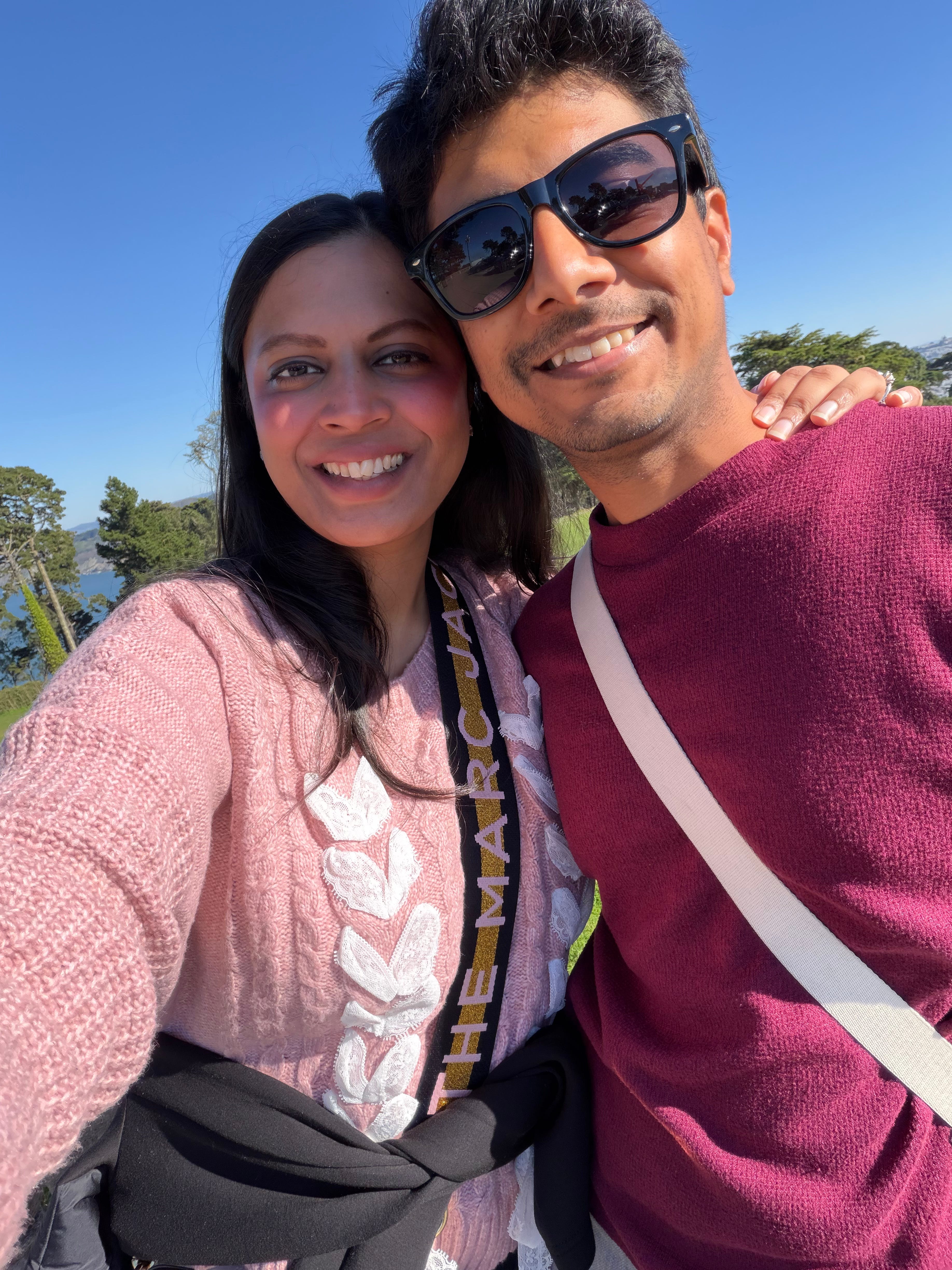
“I refused for my identity to be limited to - ‘someone’s spouse’. It’s a very nice thing, I love it and I’m proud of it, but I’m not sure if people take it the same way,” she said. “In my head, I am doing a lot. But they don’t see it. They don’t see the struggle and support that goes behind the founder’s journey. How the spouse’s life is uprooted, about how they are contributing to the husband’s — or I should say partner’s — life. They don’t see those struggles.”
She corrected herself to take a gender neutral stand in reference to trailing spouses, but did she need to? I don’t see men doing this sort of life-altering cross-continental trapeze. Some visas, especially the ones that have dependency baked into them, have become the unofficial preserve of women. I myself quit a fantastic job back home to move here for my husband; now I call myself a full-time artist on substack.3
But we didn’t dwell on this and segued instead into what I think is the beating heart of our conversation:
Kriti dreams of a community, a “safe space” for the spouses of tech founders who land up in the valley, depressed, disoriented and dependent.
“All these founders who moved from India - they have these VCs who back them. They have these huge founder networks that support them and start preparing them. And they have this shared space where they can talk about their struggles and their journey, and the support they want. I don’t think the same thing is happening for the spouses — if only there was a support group for the life partners of these founders.”
I think she’s onto a brilliant idea — “When a person is being funded in India, I want their spouse to be funded at the same time.”
The speed of innovation and change in the valley is dizzying, and, as she pointed out, her calm voice belying the emotional weight of what she was saying, one is expected to fall in step quickly.
“They expect the same pace from day one. It was very difficult for me to follow through… no one prepared me for what lies ahead for me.” she said. “Founders will find a way for themselves, because no matter what, there is a paved way for them… but I am here, in an alien land, standing clueless. I don’t know where to go. I am dependent on him for my groceries, for my friends, for my source of entertainment, for my day to day happiness.”
She might’ve briefly switched to the present tense here, but she has transcended that initial, psychologically enfeebling, phase. I have come to call it ‘migratory melancholia.’4

She didn’t mirror my feminist angst, despite questions like: So you don’t blame him for putting you in this position?
“I love him for putting me in this position,” she said instead. “I have no complaints, no regrets. In fact, I don’t think, today, I can see myself back in India. I have adapted to my life here. And I love that independence. I love that freedom for myself. I like the life I’ve created for myself.”
She is generous with her praise for her husband: “I don’t think I could get a more supportive spouse than him. No words do justice to him. He is such a great guy. He motivates me, he has always prompted me to be the best version of myself, to not limit myself, to try new things, I owe everything to him… I can say this today because I’m in a much more secure, comfortable place.”
I wrote about my own experience as a ‘visa bride’ in a personal essay for Business Insider. Read it here.
I ponder these questions in an essay I wrote in the dawn of 2023, soon after I moved here from Mumbai. I called it ‘100 Bays In The Bay’ - it was first published by India Currents.
I wrote an essay about my own experience as a trailing spouse in a piece for KQED. In it, I describe ‘migratory melancholia’ in detail. Read it here.
Thank you Ashwini bringing out such wonderful stories of resilience! I love this story, so full of hope and light :)
I loved reading this one!!! More power to Kirti :)